

UK · Europe · Scandinavia · Worldwide projects
Ro-Ro shipping for heavy machinery & project cargo
Get your equipment from collection point to destination with the sea crossing, cargo handling and inland transport planned together.
Start with your route, cargo dimensions and weight.
The right way on board
Three ways to move your cargo by Ro-Ro.
Ro-Ro means roll-on, roll-off: cargo travels aboard using its own wheels or tracks, a road trailer, or specialist wheeled handling equipment. ENKEL arranges the configuration around your load and route.
01 / SELF-PROPELLED
Machinery that drives on
Excavators, drilling rigs, mobile cranes, pavers, agricultural machinery and commercial vehicles.
What we check: operating condition, steering and braking, ground clearance, dimensions and any attachments.
02 / TRAILER-BORNE
Cargo that stays on a trailer
Machinery and project loads carried on a suitable road trailer or low-loader for the sea crossing, where the service accepts the combination.
What we check: total loaded dimensions, axle loads, securing and the arrangements at both ports.
03 / STATIC & OVERSIZED
Equipment on roll-trailers
Industrial units, offshore equipment, tanks and structures loaded onto roll-trailers or cassettes for the voyage.
What we check: support points, centre of gravity, lifting access, securing and suitable handling equipment.
Not sure whether your equipment is suitable?
Send the route, dimensions and a description. We will assess the loading method and available transport options.

A real project. A considered route.
A 6.52-metre-wide A-frame. A route beyond the obvious.
For a UK–Singapore shipment, ENKEL used a Ro-Ro cassette crossing from Tilbury to Antwerp as the first sea leg.
A barge transfer resolved a terminal access constraint before onward breakbulk shipment to Singapore. The complete route was planned around the cargo and the handling interfaces.
Explore the transport solution →Project experience
Heavy machinery. Real routes. Proven coordination.
See how the sea crossing fits into the wider transport operation.
-
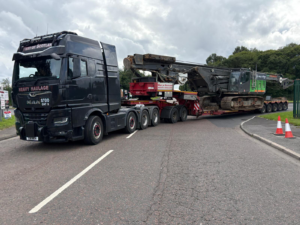
Delmag RH28 heavy haulage from Glasgow to Austria
ENKEL coordinated a 68-tonne Delmag RH28 from Glasgow to Austria, combining specialist low-loaders, route permits and a revised sea crossing via Rotterdam.
-

Construction machinery transport from UK to Croatia – case study
Delivery of used road construction machinery from Northern England to Dubrovnik via a multimodal route. The cargo exceeded standard width due to attached components, creating challenges for road transport. We resolved the issue en route…
Before the cargo reaches the port
A booking is only one part of the job.
ENKEL is a UK-based project logistics company. We coordinate the transport partners, sea service and handling arrangements within one agreed scope.
Confirm the cargo
Check actual transport dimensions, unit weights, mobility and attachments against photographs or drawings.
Check the sea option
Assess vessel and terminal acceptance, deck and ramp constraints, equipment availability and sailing options.
Align both ends
Coordinate collection, permits where needed, loading, securing, documentation and onward transport.
Manage the movement
Align port cut-offs and handovers, follow shipment progress and coordinate delivery to the agreed destination.
Route planning
Across the North Sea. Across Europe. Further afield.
UK ↔ Europe
Short-sea crossings connected to road transport for machinery and project cargo moving between the UK and continental Europe.
Explore heavy haulage →UK ↔ Scandinavia
Transport involving Finland, Sweden, Norway and Denmark, with the port pair selected around cargo acceptance and inland mileage.
Finland–UK transport →Worldwide projects
Deep-sea Ro-Ro where suitable, or a Ro-Ro leg combined with breakbulk or special-container shipping for the onward journey.
Explore breakbulk options →Sailing availability, direct or connecting routes and cargo acceptance are checked for each enquiry. Collection and delivery addresses help us compare the complete transport cost.
Have photographs or drawings? Email them to our team.
Can used or non-running machinery travel by Ro-Ro?
Used machinery can be considered, subject to its condition and the carrier, terminal and destination requirements. Non-running equipment needs an agreed handling method; a roll-trailer may be an option. Tell us about mobility, leaks, damage or missing components before booking.
What determines the Ro-Ro shipping price?
The route, sailing, total dimensions, weight, mobility and handling requirements all affect the price. Inland haulage, terminal services, securing and documentation also need to be included where required. Send collection and delivery locations so the scope and exclusions can be made clear.
What are the maximum dimensions and weight?
There is no single limit across Ro-Ro services. Ramp capacity, deck height, deck loading, access and handling equipment vary. Send the actual transport dimensions and weight, including attachments and supports, for a route-specific assessment.
Can you arrange collection and final delivery?
Yes. ENKEL can coordinate inland transport, port handling and the sea leg within the agreed scope. Specialist road equipment, permits and escorts can be arranged where required. Port-to-port enquiries are also welcome.
What documents and preparation are needed?
Requirements depend on the cargo and destination. Typical information includes a commercial invoice, cargo details, serial numbers and export or import instructions. Cleaning, fuel or battery conditions and securing requirements must be checked for the selected service. We can coordinate customs arrangements within the agreed scope.
When is a flat-rack or breakbulk solution more suitable?
If the route, loaded dimensions, cargo condition or handling requirements do not fit the available Ro-Ro service, we can assess flat-rack and open-top shipping or a breakbulk solution. We compare the practical transport chain, including handling and inland legs.
Let’s plan your shipment
Tell us what needs to move.
Share the cargo and route. We will review the transport options and confirm any further details needed for your quote.
What happens next: we review the cargo, check the route and handling requirements, and contact you with the next steps towards a scoped quotation.