
This case study covers construction machinery transport from the UK to Croatia, including handling of dimensional discrepancies and route optimisation across Europe.
Cargo particulars and task
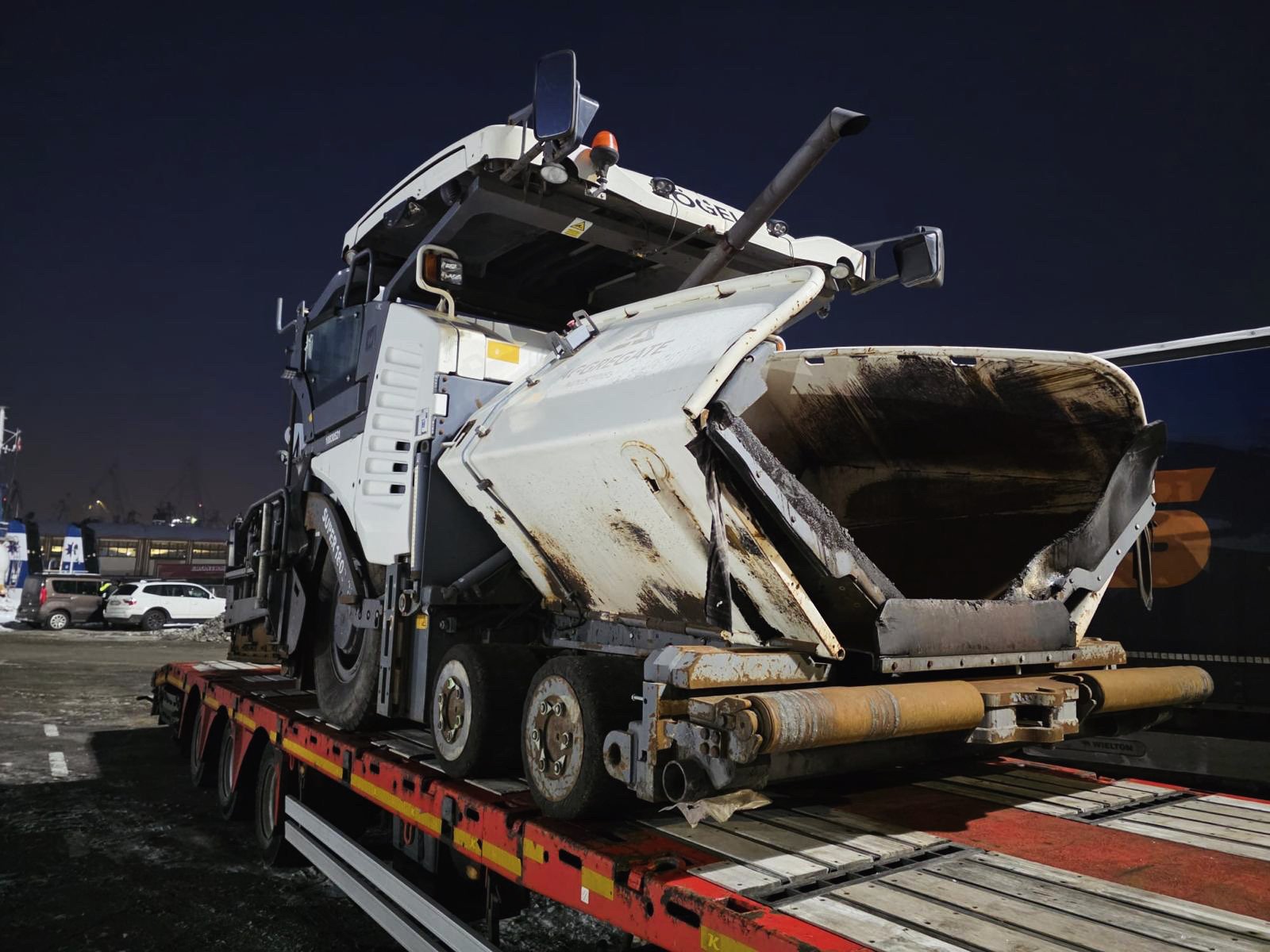
We were approached to arrange delivery of construction machinery, a used Vogele 1803-3i road paver, from the North of England to Dubrovnik, Croatia.
The unit was self-propelled and had standard transport dimensions of 6.0 × 2.6 × 3.1 m, with a gross weight of 17,800 kg. Based on these parameters, the cargo initially appeared suitable for standard road transport within Europe.
However, as often happens with used construction equipment, the actual transport configuration differed from nominal specifications. The unit was fitted with additional attachments, which had not been fully accounted for at the planning stage.
Solution: multimodal Ro-Ro + overland transportation
We developed a multimodal transport solution combining road and short sea shipping.
The machine was collected in the North of England and transported by low loader to the port of Sheerness. From there, it was shipped via Ro-Ro ferry to Gdynia, Poland. Final delivery to Croatia was arranged by road transport.
This routing allowed us to avoid a long overland haul across Western Europe and significantly reduce transport costs. It also provided flexibility in case adjustments were required during transit.
Challenge: incorrect cargo dimensions
The main issue became apparent upon arrival in Gdynia.
Due to the installed attachments, the actual transport width of the unit was measured at approximately 3.1 m. This exceeded the initially expected dimensions and changed the transport classification.
For road transport across Central and Southern Europe, a width of 3.1 m is a critical threshold. It requires special permits, route surveys and, in some cases, escort vehicles depending on the country.
Proceeding with the cargo in this condition would have resulted in delays, additional costs and operational constraints along the route to Croatia.
This situation is typical for used construction machinery transport, where nominal specifications often do not reflect the real transport envelope.
What was done
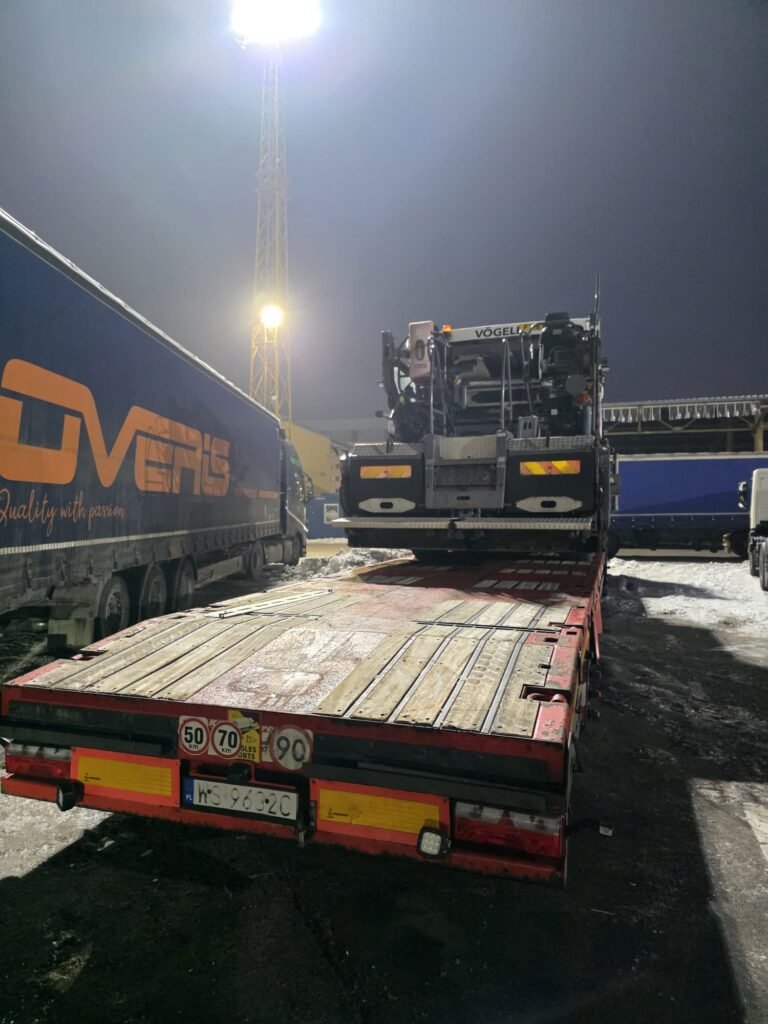
To resolve the issue, we arranged a technical stop in Poland.
The vehicle was routed to a local workshop, where the additional attachments were dismantled. This reduced the overall width of the unit to within standard transport limits.
The dismantling process was planned to ensure that no damage occurred to the equipment and that reassembly at destination would remain straightforward.
Once the width was reduced, the transport could proceed without requiring complex permit arrangements or escort vehicles.
Result
The cargo was delivered successfully to Dubrovnik without delays.
The selected multimodal solution provided cost efficiency while maintaining flexibility to adapt to unexpected changes in cargo dimensions.
We regularly arrange construction machinery transport across Europe, including Ro-Ro shipping and multimodal solutions.
Our services include:
If you are looking for a good way to move your construction machinery, feel free to get in touch.