
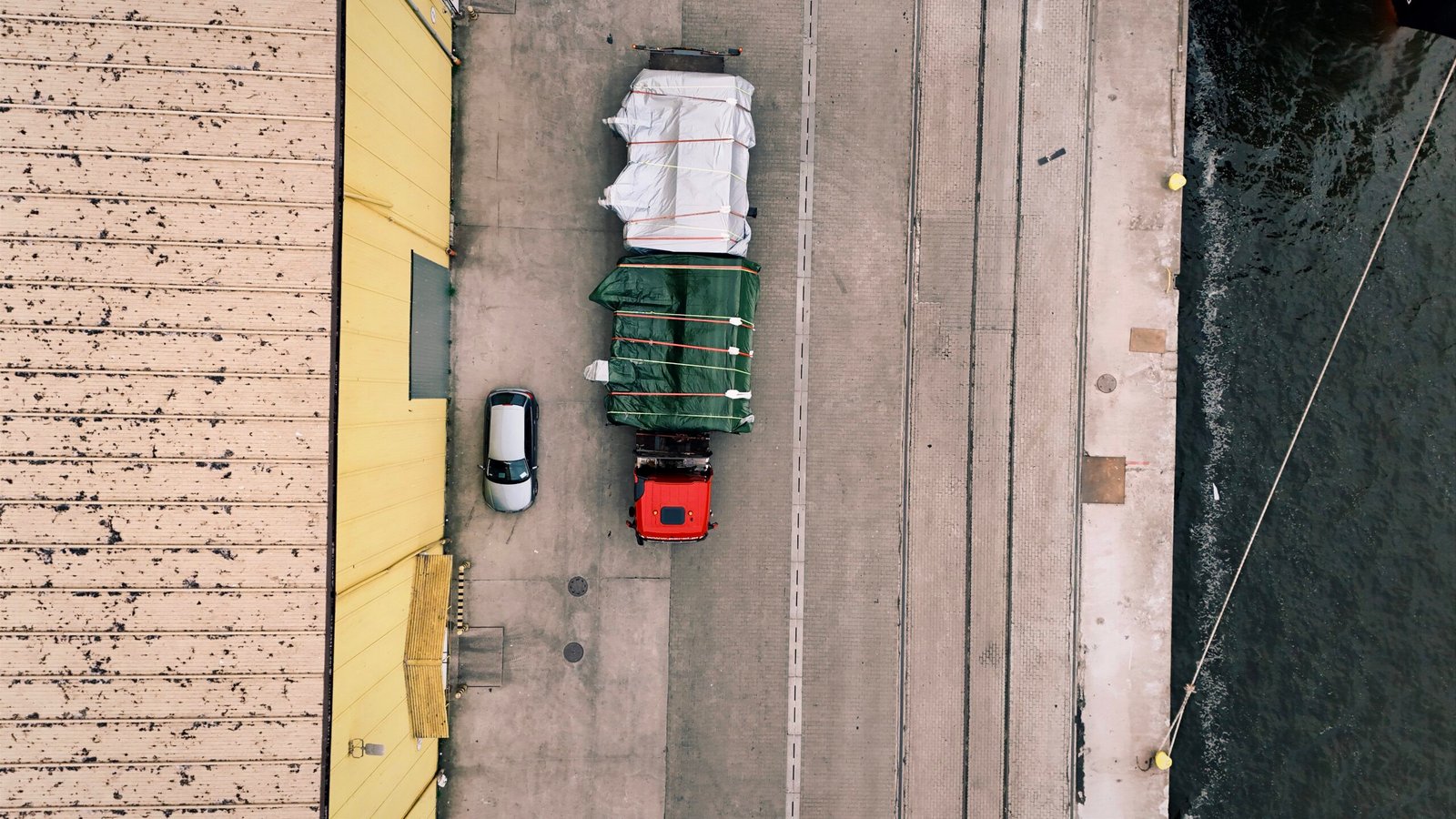
This case study covers OOG transport to Norway of oversized offshore platforms using breakbulk liner shipping.
Cargo particulars and task
We arranged delivery of several oversized offshore platforms and related equipment from Słupsk, Poland to Brattvåg, Norway.
The cargo included large fabricated steel units such as L-hatches, ROV doors and platform sections. Some pieces had a width close to 5.7–6.0 meters and lengths up to 12.6 meters, making them unsuitable for standard transport.
Due to their geometry and footprint, the cargo required detailed loading planning and careful execution at every stage — from factory pickup to vessel loading.
Engineering and preparation
Before execution, we developed a detailed loading plan covering trailer allocation, cargo positioning and securing methods.
Three extendable flatbed trailers were assigned for the overland transport. Each unit was pre-positioned based on dimensions and weight distribution.
The loading sequence for handling at port was defined in advance:
- widest units placed with proper extension and support
- heavier items positioned centrally
- smaller cargo used to optimise deck space
Dunnage was applied under all steel structures to avoid direct contact and improve friction. Height and overhang were controlled to remain within operational limits.
This preparation ensured that loading at origin proceeded without delays.
Solution
Transport was executed in two stages.
First, cargo was moved by road from Słupsk to the port of Świnoujście.
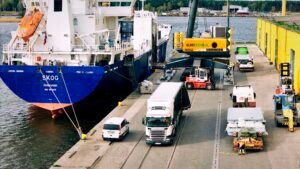
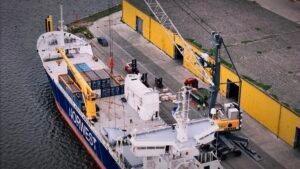
From there, we arranged shipment on a breakbulk liner vessel to Brattvåg.
Instead of chartering a vessel, we secured space on a scheduled liner service. This allowed us to combine the cargo with other shipments and significantly reduce freight costs.
For cargo of this size, such solutions are not always obvious, but when available, they provide a strong commercial advantage.
Challenges
The key challenge was the width of the cargo. Oversized cargo transport to Norway often involves constraints related to road permits, terminal access and vessel compatibility.
Several units approached 6 meters, which is well beyond standard road transport limits in Europe.
Transport required:
- careful route planning
- coordination with local authorities
- real-time adjustments during execution
Due to ongoing roadworks along the route, additional constraints appeared. In certain locations, road signs had to be temporarily removed to allow passage of the convoy.
In other areas, detours were required to avoid restricted sections.
These factors increased operational complexity and required continuous coordination with drivers and local teams.
What was done
We managed the full transport chain, including:
- loading supervision at the factory in Słupsk
- implementation of the pre-approved loading plan
- coordination of oversized road transport to port
- handling of route constraints and infrastructure limitations
- port operations and vessel loading in Świnoujście
The cargo arrived at the terminal in sequence and was loaded directly onto the vessel using shore cranes.
Due to proper preparation and sequencing, port operations were completed efficiently without rehandling or delays.
Result
The cargo was delivered successfully to Brattvåg. Despite challenging dimensions and route constraints, the transport was executed smoothly and without incidents.
The use of a liner vessel allowed us to achieve a cost-efficient solution, which is often difficult to obtain for cargo of this width.
Read more about this project on Workboat 365.
We regularly arrange oversized cargo transport to Norway and across Scandinavia, including offshore structures, steel fabrications and industrial equipment.
Learn more about our:
If you are dealing with similar cargo, feel free to get in touch.